Define done
Set the goal, its acceptance checks, the allowed scope, and a budget.
 kaziGitHub
 Your coding agent has the ability.
Kazi gives it a finish line.
A continuous loop that turns your goals into checked results.
It keeps your agent working until every check passes, or tells you what’s blocking it.
Your coding agent says "done." kazi proves it.
Kazi is the outer/reconciliation loop for coding agents. Think of it as Kubernetes for coding goals: declare the desired outcome, then close the gap.
You describe the outcome. Your agent drafts the acceptance checks. Kazi observes what is failing, sends the work back to the agent, and checks again.
Tests, exact file contents, a live endpoint: you choose what completion means. Kazi reports success only when every declared check passes.
Read the engineering behind it ↗Set the goal, its acceptance checks, the allowed scope, and a budget.
Failing checks become the agent’s next assignment. Kazi rechecks after the work.
Converged, stuck, or over budget. Every stop has a reason you can act on.
One failing Go test. A real agent run.
A result verified by the controller.
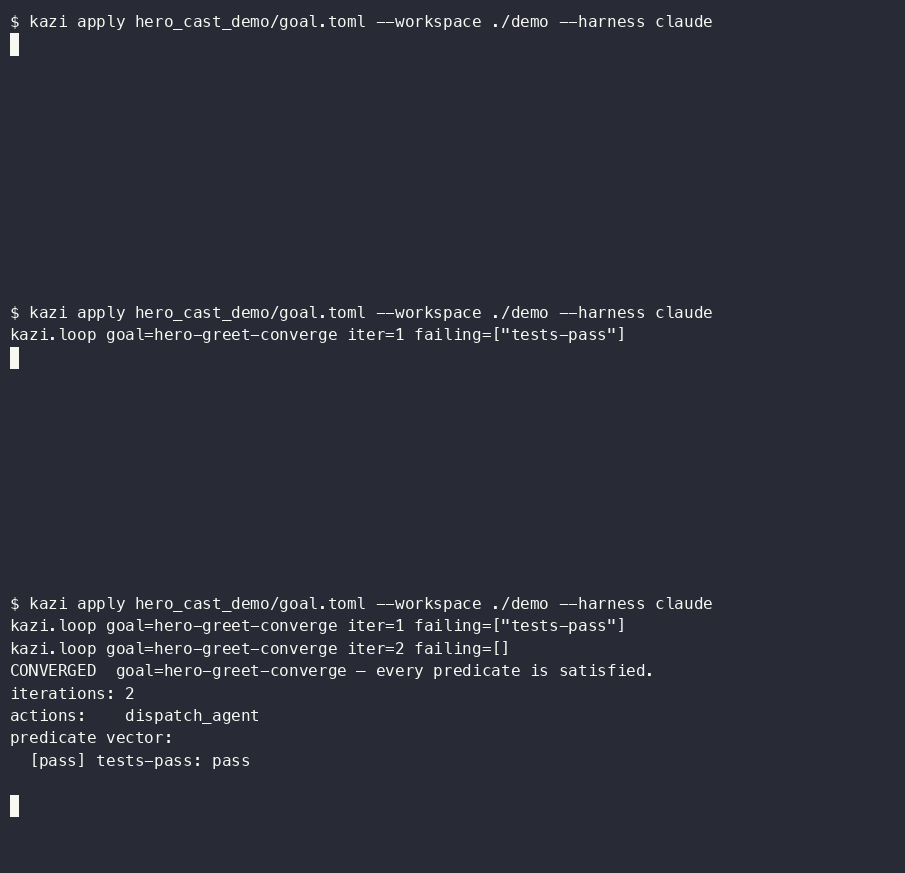
The goal required VERSION.txt to contain exactly 1.0.0. Kazi checked the bytes and drove the run to convergence in 2 iterations.
iterations to verified completion
One recorded run, not a performance guarantee.
Completion belongs to the controller. Stored evidence makes each result inspectable. The strength of that result depends on the checks you define.
Resource leases coordinate overlapping edits. A session bus lets agents exchange updates, while the dashboard makes fleet progress visible.
Start with Claude Code. Kazi also supports other CLI harnesses, including Codex and opencode, with documented support tiers.
Compare harness support ↗Iteration, time, and token budgets bound the run. Repeated failures surface as stuck, so the next decision returns to you.
Use a stronger model to define the work, then a cheaper one for iterations. Let the orchestrating skill escalate difficult slices. Savings are an intended benefit, not a measured promise.
Connect opencode to a local model when your workflow calls for local inference. Data handling still depends on the model, tools, and services you configure.
Install Kazi once. Add its skill to Claude Code.
Then describe the outcome you want to ship.
Requires Homebrew and a configured Claude Code installation. The Kazi binary includes its runtime.
Other platforms and source builds ↗
brew install kazi-org/tap/kazi
kazi install-skill
/kazi plan "add a /healthz endpoint
that returns 200 ok, with a test,
deployed"
/kazi apply
Prefer plain English? Say have kazi drive this until done in Claude Code after installing the skill.
The skill installs locally. Kazi drives your coding agent; it does not bundle one.
Kazi is a reconciliation controller around the coding agent you already use. The agent edits code. Kazi evaluates the checks and decides whether more work is needed.
A passing run means all declared acceptance checks passed. Missing or weak checks leave gaps. Review the proposed checks before applying a goal, and include the deployed behavior when that matters.
Kazi can stop as stuck when failures repeat, or over budget when a run reaches its configured limits. You can inspect the evidence, refine the goal, or change the approach.
Kazi is open source under Apache-2.0. Your coding agent, model provider, and infrastructure may have their own costs. Read the license.
Yes. Acceptance predicates can probe a live endpoint. Deployment requires your own configured commands, tools, and access. Include the live check in the goal when production behavior defines done.
Use GitHub Issues for bugs and Discussions for questions. The repository includes setup instructions, architecture decisions, and reproducible examples.
Useful AI needs dependable engineering.
I created Kazi to make completion something a system can verify. It reflects the way I approach automation: clear outcomes, explicit checks, and a reason for every stop.
Through my consultancy, I build custom AI automations for business workflows, connected to real tools with human approval gates. Kazi is one piece of that engineering, open for you to inspect.
Work with David Explore my open-source work ↗